Automation runs safety-critical processes well inside their design envelope. Abnormal situations still fall to human operators, and their mismanagement is a leading contributor to process-safety incidents. Full autonomy in other domains usually leans on a safe stop. A chemical plant does not have that recourse because stopping is itself a hazardous and expensive operation.
This project asks whether a general-purpose large reasoning model (LRM), with no task-specific training and only the information available to an operator, can manage abnormal situations at run time, provided it acts through an interface that cannot express an unsafe command.
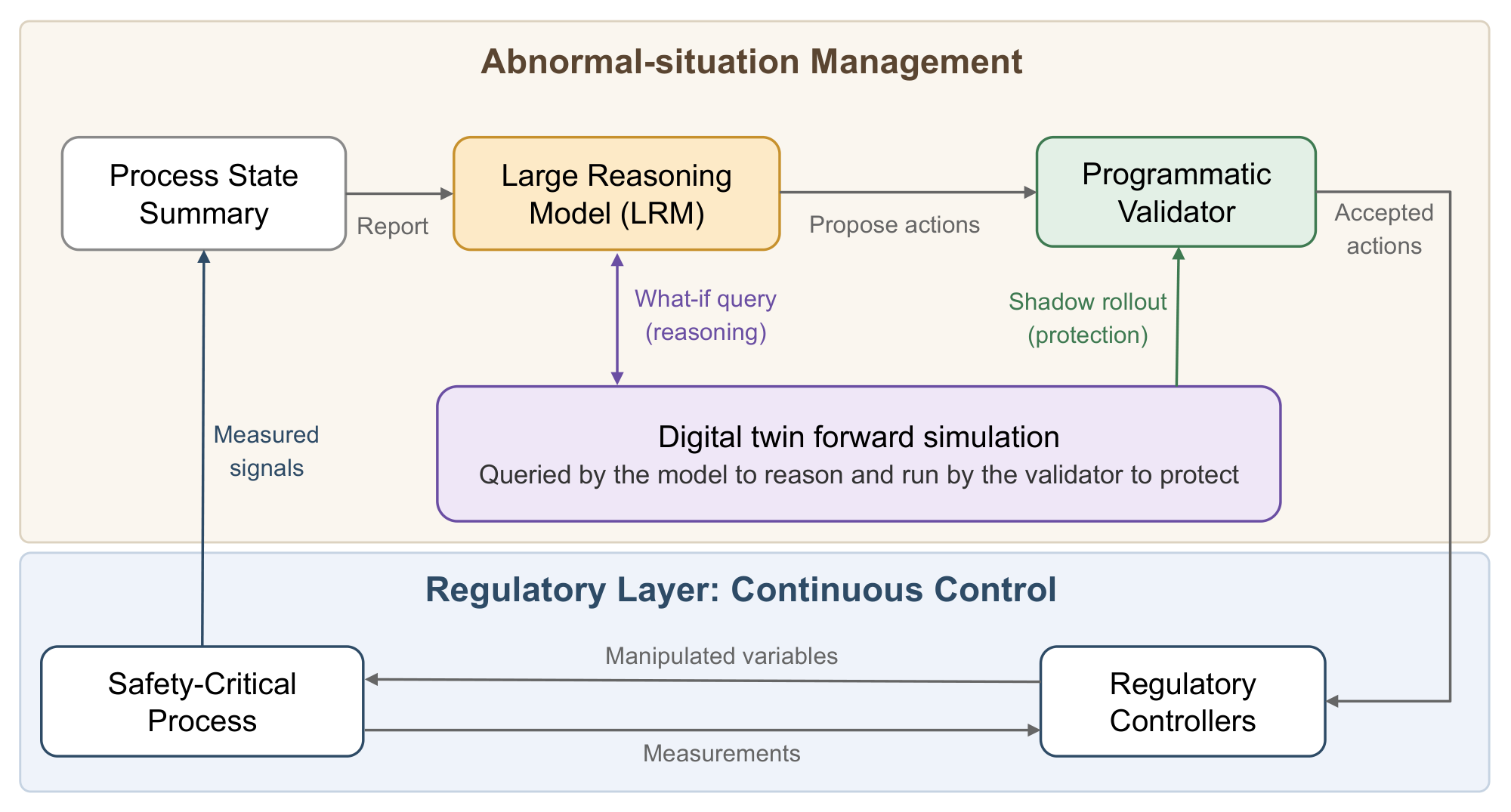
The LRM operates as an abnormal-situation-management layer above the decentralized regulatory (PID) controllers. It sees only a measured process-state summary and proposes actions from a bounded interface, and every proposal passes a programmatic validator backed by a digital-twin shadow rollout.
How it is guarded
- Bounded action interface. The model chooses among a small set of generic supervisory moves. It can adjust setpoints, reconfigure control, run a procedure, distrust a suspect instrument, do nothing, or recommend shutdown. Direct actuator manipulation is not representable.
- Programmatic validator. Every proposal is checked against static bounds, rates, cooldowns, and a per-episode budget. The validator returns machine-readable reasons for a single revision.
- Shadow rollout. A nominal-model digital twin serves two roles. The model queries it to reason about a candidate action, and the validator runs it as a shadow simulation to veto any move predicted to trip the plant.
Knowledge is split in two. A process-agnostic reasoning doctrine lives in the system prompt, while a generated, plant-specific description supplies the numbers and mechanisms. Moving to a new process means regenerating one document rather than re-engineering the method.
The benchmark covers 39 episodes on a plant-wide industrial process built on the Tennessee Eastman simulator. The episodes span cases where no intervention is needed, cases where a safety limit is approached, and cases where a commanded quality change exceeds what the baseline can track. The model kept the plant within every hard constraint in every episode.
Code and benchmark are available at github.com/khalidlabs/safetep-core, built on the TEP Studio simulation kernel.