Selective hydrogenation units remove trace methylacetylene and propadiene (MAPD) from a propylene stream. The more selective way to dose hydrogen is to ratio it against the measured inlet MAPD concentration. That strategy requires a continuous and trustworthy MAPD signal at every control interval, and the online gas chromatograph (GC) that provides it is intermittent and occasionally unreliable.
A soft sensor intended for closed-loop use cannot be judged as a standalone predictor. Low aggregate error and near-nominal interval coverage can still hide local reliability loss during operating-state transitions, which is exactly when a controller can least afford a bad measurement. The soft sensor is therefore treated as part of a reliability-aware measurement layer that decides, at each step, whether to trust the analyzer, rely on the model, or route the controller to a conservative fallback.
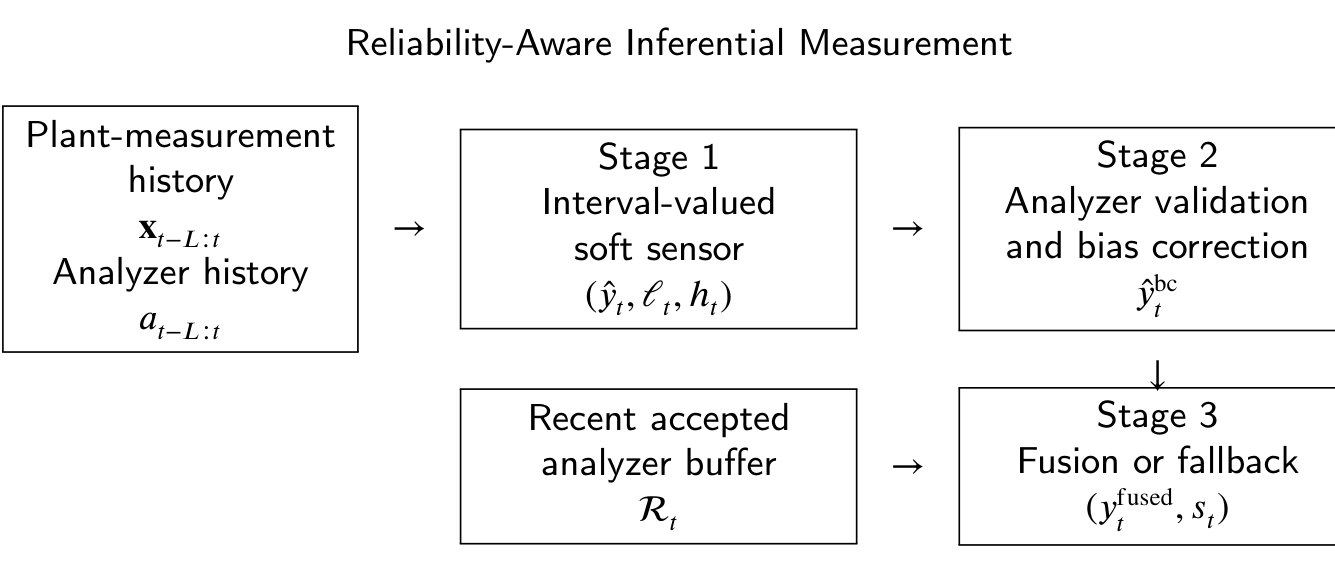
The three-stage architecture. An interval-valued soft sensor, analyzer validation with bias correction, and a fusion-or-fallback stage that emits a continuous measurement together with a status flag identifying the active source.
Approach
- Interval-valued prediction. A temporal convolutional network with MC-dropout and split-conformal calibration emits a value and a prediction interval. The interval width serves as an operational reliability signal.
- Analyzer validation and bias correction. Incoming GC readings are validated and fused through a robust bias filter rather than trusted blindly.
- Source selection with fallback. An operating-domain monitor adds a representativeness check. When neither the analyzer nor the model is eligible, the layer falls back conservatively and flags the active source.
The method is evaluated on one year of industrial reactor historian data with chronological holdout testing and GC-withholding windows that emulate extended analyzer outages. Among the models compared, the conformally calibrated TCN gave the best balance of accuracy and empirical coverage.
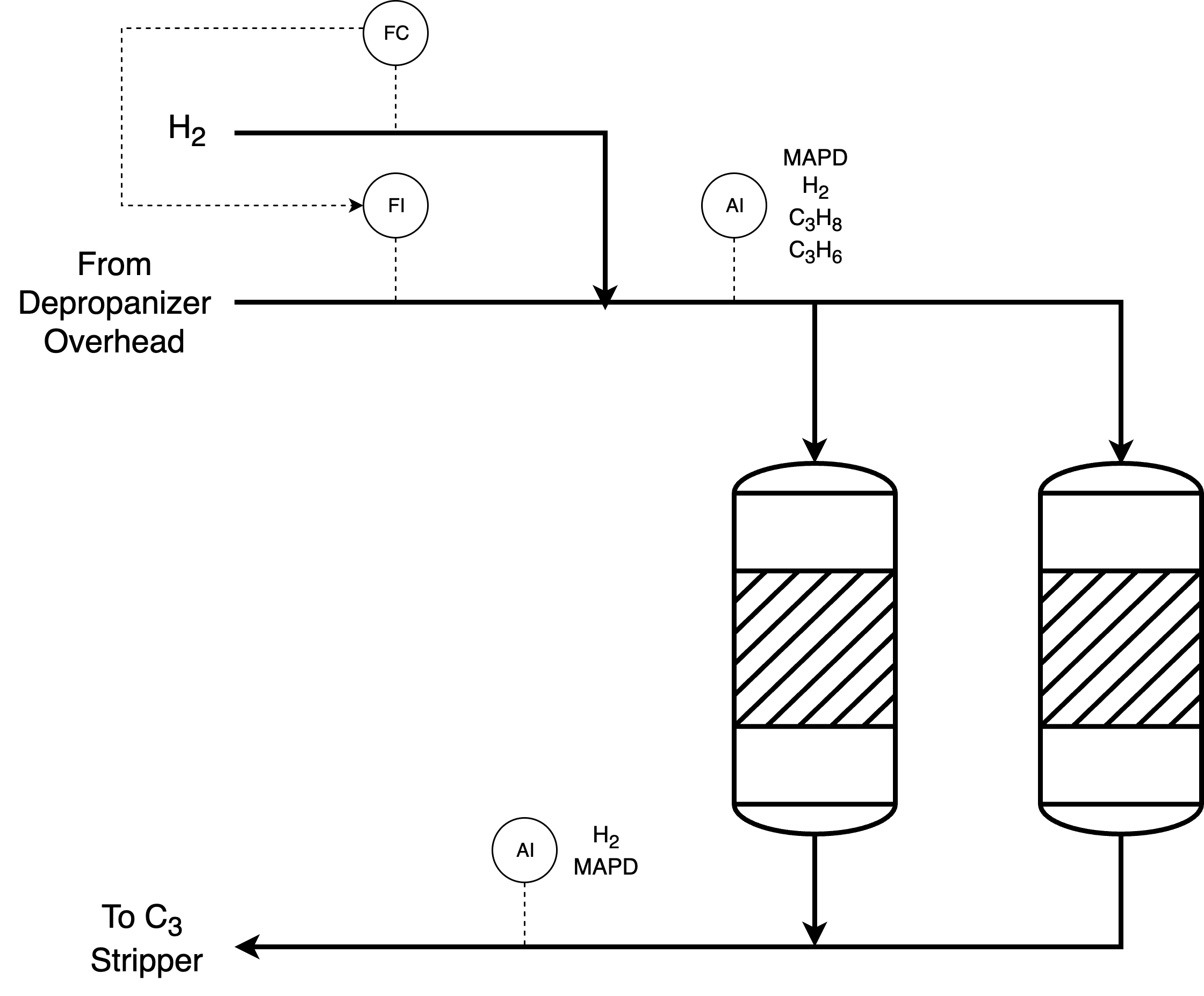
The selective hydrogenation section. Hydrogen is dosed into the depropanizer overhead feed ahead of lead and lag fixed-bed reactors, with analyzers on the reactor inlet and outlet.
Soft sensing for analyzer-dependent control is a deployment problem. Prediction accuracy and online measurement reliability must be assessed together before the estimate is allowed to move a valve.
Manuscript submitted to the Journal of Process Control (2026).